The Psychology of the Learner Zone: Bridging the Gap Between Struggle and Mastery
We have all witnessed the profound frustration of a child staring at a math problem they cannot solve or an adult attempting a new skill that feels entirely out of reach. Frustration easily turns into defeated resignation when tasks are too complex. Conversely, tasks that are too simple produce boredom rather than growth. Between these two extremes lies a space where true cognitive expansion occurs.
Psychologists refer to this optimal space of growth as the learner zone. In clinical and educational settings, identifying this space is essential for fostering resilience and lasting capability. By targeting the exact boundary of current abilities, we can provide the precise psychological and structural support needed for a person to thrive.
What is the Learner Zone?
The learner zone is the specific gap between what a person can accomplish independently and what they can achieve with targeted guidance. This concept originates directly from Lev Vygotsky and his sociocultural theory of learning. Vygotsky originally termed this the zone of proximal development.
This framework challenges the traditional reliance on static intelligence testing. Standard tests only measure completed development or existing knowledge. In contrast, the learner zone evaluates potential. It maps the terrain of what a student is on the verge of mastering if provided with the correct temporary assistance.
The Three Spaces of Cognitive Growth
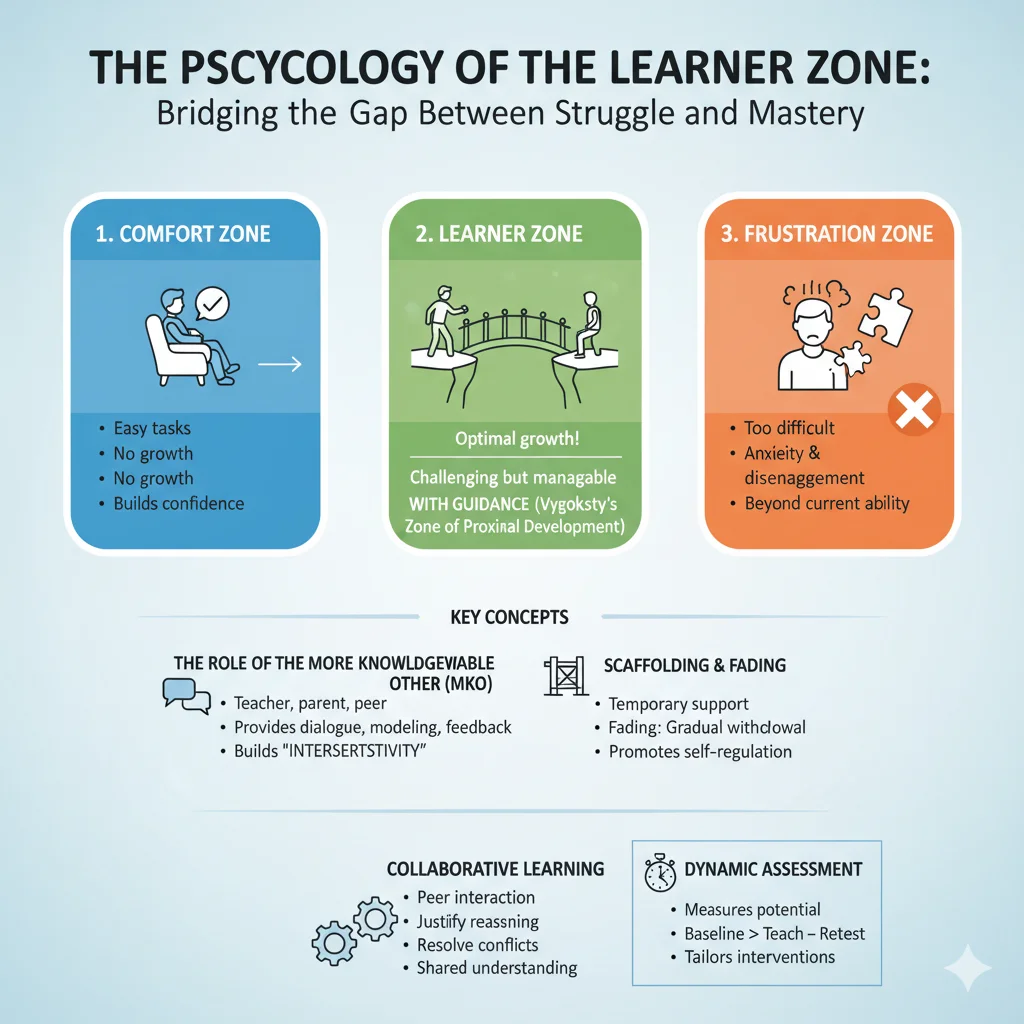
To fully understand how humans acquire new abilities, we must divide cognitive tasks into three distinct spaces. The first space is the comfort zone. Here, individuals complete tasks flawlessly without any external input. While confidence builds here, active cognitive expansion remains stagnant because no new challenges exist.
The second space is the learner zone. Tasks in this area are impossible to complete alone but become entirely manageable with collaboration. This is the sweet spot of learning. A knowledgeable mentor provides a bridge of understanding, allowing the individual to internalize new strategies and problem-solving methods.
The third space is the frustration zone. These tasks sit far beyond current cognitive capacities. Even with expert guidance, the individual cannot grasp the underlying concepts. Instruction placed in this zone causes anxiety and disengagement, highlighting the importance of accurately identifying a person’s current readiness level.
The Role of the More Knowledgeable Other
Learning is fundamentally a social and collaborative process. Vygotsky introduced the concept of the More Knowledgeable Other to describe anyone who possesses a higher skill level than the learner. This figure is frequently a teacher or parent, but peers often serve just as effectively in this critical role.
The More Knowledgeable Other serves as an external cognitive anchor. Through dialogue, modeling, and direct feedback, this individual translates complex concepts into digestible pieces. This dynamic interaction creates an interpersonal bridge. The learner slowly internalizes the language and logic used by the mentor during their collaborative efforts.
Intersubjectivity in Clinical and Educational Settings
For collaboration to succeed, both parties must establish intersubjectivity. This term describes the shared understanding that develops when an expert and a novice work toward a common goal. They must align their perspectives so the mentor can accurately interpret the subtle cues of the struggling student.
In my clinical practice, building intersubjectivity is the foundation of therapeutic growth. If I suggest behavioral interventions that sit outside a client’s current emotional capacity, the therapeutic alliance fractures. True progress requires adjusting my clinical language to match the exact developmental and emotional reality of the individual.
Psychological Mechanisms of Scaffolding
Scaffolding represents the temporary and highly adaptive support structure provided during the learning process. Just as physical scaffolds support a building under construction, psychological scaffolds hold a learner steady while they build internal cognitive frameworks. The support is intentionally temporary and inherently responsive to the student.
Effective scaffolding requires careful contingency. The mentor must constantly monitor the student and adjust the level of intervention in real time. When a learner struggles, the mentor increases structure and specificity. As the learner demonstrates independent competence, the mentor systematically reduces their active involvement and oversight.
The Process of Fading
The gradual withdrawal of support is known clinically as fading. This process is absolutely critical for the development of self-regulation and autonomy. If a mentor maintains high levels of assistance for too long, the individual risks developing learned helplessness rather than true mastery of the required skill.
Fading shifts the cognitive burden entirely onto the learner. Through repeated practice without external cues, the knowledge transitions from an interpersonal shared experience to an intrapersonal permanent skill. The learner internalizes the mentor’s voice, which transforms into their own metacognitive dialogue for future problem-solving scenarios.
How Collaborative Learning Expands the Learner Zone
Modern research extends traditional theories by highlighting the power of peer collaboration. Group environments create a symmetrical learning space where individuals of similar expertise challenge one another. This transactive discussion forces students to clarify, elaborate, and justify their reasoning to peers without relying on an authority figure.
Defending an idea against a peer’s critique triggers profound metacognitive awareness. The student must analyze their own thought process to articulate a defense. This mutual engagement resolves cognitive conflicts organically. Through joint problem-solving, the entire group achieves a new level of shared understanding and advanced capability.
Practical Applications for Dynamic Assessment
Traditional testing falls short because it ignores a student’s capacity to learn in real time. Dynamic assessment offers a robust alternative by evaluating how well a person responds to intervention. The examiner tests a baseline, teaches a specific strategy, and immediately retests to measure the exact potential.
This assessment style clearly outlines the individual’s optimal learning boundaries. Psychologists and educators use these results to tailor precise interventions. By focusing on responsiveness rather than static memorization, we map a realistic trajectory for growth that respects the unique neurological and cultural background of the student.
Conclusion
Navigating the complex landscape of cognitive development requires patience and precision. It is entirely normal to feel overwhelmed when facing a task that initially defies understanding. Recognizing the boundary between healthy challenge and counterproductive frustration is a vital skill for both educators and students to cultivate daily.
By actively seeking the optimal space for guided growth, we remove the stigma of requiring assistance. We learn best through connection, dialogue, and carefully structured support. Embracing this collaborative approach ensures that today’s guided practice will reliably transform into tomorrow’s independent competence and lasting psychological resilience.
Key Takeaways
- The learner zone dictates the exact space where tasks are challenging enough to build skills but manageable enough to prevent despair.
- Mastery requires the temporary support of a knowledgeable mentor who can model solutions and provide immediate feedback.
- Scaffolding must remain highly responsive, increasing during moments of confusion and fading away as independent competence grows.
- Shared understanding and mutual engagement between teacher and student remain essential for any successful transfer of complex knowledge.
- Peer collaboration naturally expands cognitive boundaries by forcing individuals to justify their reasoning and resolve conflicting ideas together.
References
- Bruner, J. S. (1985). Vygotsky: A historical and conceptual perspective. In J. V. Wertsch (Ed.), Culture, communication, and cognition: Vygotskian perspectives (pp. 21-34). Cambridge University Press.
- Goos, M., Galbraith, P., & Renshaw, P. (2002). Socially mediated metacognition: Creating collaborative zones of proximal development in small group problem solving. Educational Studies in Mathematics, 49(2), 193-223.
- Rogoff, B. (1990). Apprenticeship in thinking: Cognitive development in social context. Oxford University Press.
- van de Pol, J., Volman, M., & Beishuizen, J. (2010). Scaffolding in teacher-student interaction: A decade of research. Educational Psychology Review, 22(3), 271-296.
- Vygotsky, L. S. (1978). Mind in society: The development of higher psychological processes. Harvard University Press.
- Wood, D., Bruner, J. S., & Ross, G. (1976). The role of tutoring in problem solving. Journal of Child Psychology and Psychiatry, 17(2), 89-100.