Dysthymia and depression share many symptoms, but they are not the same condition. Understanding the difference between dysthymia and depression matters, because the two conditions differ in how long they last, how severe they feel, and how they are treated. This guide explains both, side by side, so you can recognise what sets them apart and know when to seek help.
Both conditions involve persistent low mood, and both can seriously affect daily life. The key distinction is the pattern: one is a long-lasting, lower-grade low mood, while the other comes in more intense episodes. Knowing which pattern fits your experience — or a loved one’s — is a useful first step toward the right support.
Key Takeaways
- Dysthymia is now called persistent depressive disorder (PDD). It is a long-term, usually milder form of depression lasting at least two years.
- Depression usually means major depressive disorder (MDD): more severe episodes that last at least two weeks but are often shorter than PDD.
- The main differences are duration, severity, and pattern — PDD is constant and low-grade, MDD is episodic and more intense.
- Both are diagnosed by a mental health professional using recognised criteria, and both respond to psychotherapy and, where needed, medication.
- It is possible to have both at once — an episode of major depression on top of persistent depressive disorder.
- If symptoms persist or include thoughts of self-harm, seek professional help promptly.
What Is Dysthymia?
Dysthymia is an older name for chronic, long-term depression. It is now called persistent depressive disorder (PDD) in the Diagnostic and Statistical Manual of Mental Disorders, Fifth Edition, Text Revision (DSM-5-TR), the reference manual mental health professionals use to diagnose mental health conditions.
Unlike other depressive disorders, which involve periods of ordinary, non-depressed mood between episodes, PDD causes a low mood that goes on for years. The symptoms are usually less intense than those of major depression, which is one reason PDD can go unrecognised — people may assume that feeling low, tired, and pessimistic is simply their personality, when in fact it is a treatable condition.
Symptoms of Persistent Depressive Disorder
Symptoms of PDD are often less obvious than those of major depression. They can look like gloominess, pessimism, or low energy that never quite lifts. The symptoms are present most of the time, though they can vary in strength. They include:
- Persistent low or gloomy mood
- Little sense of humour or enjoyment
- Pessimism and feelings of hopelessness
- Low self-esteem and self-criticism
- Passivity and difficulty making decisions
- Lethargy and low energy
- Introversion and withdrawal from others
- Sleep problems — too much or too little sleep
- Appetite changes — eating more or less than usual
- Poor concentration
- A general sense of dissatisfaction with life
Because these symptoms develop gradually and persist, many people with PDD do not realise their experience has a name — or that treatment could help.
What Is Depression?
When people say “depression”, they usually mean major depressive disorder (MDD), also known as clinical depression. MDD is more severe than PDD, but its episodes usually last for a shorter time. An episode can last weeks or months, and it may lift and later return if it is not treated.
MDD affects mood, thinking, sleep, appetite, energy, and the ability to enjoy life. It can make ordinary daily tasks — getting out of bed, going to work, looking after yourself — feel very difficult. Like PDD, it is a medical condition, not a weakness or a choice, and it responds to treatment.
Symptoms of Major Depressive Disorder
Symptoms can interfere with everyday functioning. They include:
- Prolonged depressed mood for most of the day
- Loss of interest or enjoyment in most activities
- Fatigue or loss of energy
- Feelings of worthlessness or guilt
- Unintended weight or appetite changes
- Sleep changes — sleeping too much or too little
- Restlessness or slowed movement and speech
- Difficulty thinking, concentrating, or making decisions
- Thoughts of death or dying
People who are more likely to be diagnosed with MDD include those lacking close, supportive relationships, those who are divorced, separated, or widowed, and those living with other mental health conditions. Depression can affect people of any age, background, or walk of life.
Dysthymia vs Depression: The Key Differences
Despite their shared symptoms, PDD and MDD differ in several important ways:
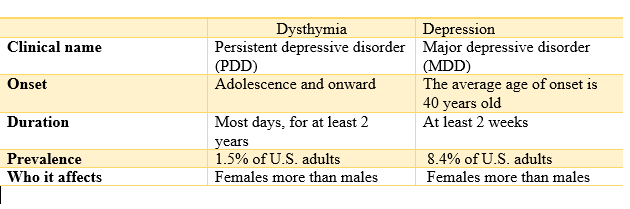
- Duration: PDD lasts for years — at least two years by definition. MDD episodes last at least two weeks, often weeks to months, and may then lift.
- Severity: MDD symptoms are usually more severe and more disruptive in the short term. PDD symptoms are typically milder but constant.
- Pattern: PDD is a steady, low-grade low mood with no long symptom-free breaks. MDD comes in episodes, with periods of normal mood in between for many people.
- Impact: Both can seriously affect work, school, and relationships. The constant nature of PDD can be just as wearing over time as the intensity of MDD.
- Diagnosis: PDD requires a low mood for most of the day, more days than not, for at least two years. MDD requires five or more symptoms, including low mood or loss of pleasure, for at least two weeks.
In short, dysthymia is depression that is milder but lasts much longer; major depression is more intense but usually shorter-lived. Neither is “less real” than the other, and both deserve proper care.
How Are They Diagnosed?
Mental health professionals use a combination of conversation, history-taking, and questionnaires to identify depressive disorders. They will ask about your mood, sleep, appetite, energy, and how long symptoms have been present, and they may use a standard screening questionnaire. A physical health check or blood tests are sometimes used to rule out other causes, such as thyroid problems or the effects of a medication.
Diagnosing Persistent Depressive Disorder
For a diagnosis of PDD, a person must have a depressed mood for most of the day, for more days than not, for at least two years. During that time, they must not have had a symptom-free period lasting longer than two months. At least two of the following must also be present: feelings of hopelessness, low self-esteem, sleep disruption, appetite changes, fatigue or low energy, and difficulty making decisions or concentrating.
Diagnosing Major Depressive Disorder
For a diagnosis of MDD, a person must have five or more of the symptoms listed above, lasting at least two weeks, and one of them must be a depressed mood or a loss of interest or pleasure in most activities. The symptoms must cause significant distress or difficulty in daily life, and they must not be better explained by another medical condition or by substance use.
Only a qualified professional can make a diagnosis. Self-assessment can be a useful starting point, but it cannot replace a proper evaluation.
Severity and Daily Life
A person living with either condition may have difficulty concentrating at work or school, keeping up with relationships, or finding the energy for everyday tasks. The symptoms of MDD are more severe but pass more quickly than those of PDD, which last for a long time. Even though dysthymia symptoms are milder, they can be just as devastating over the years — quietly limiting what a person feels able to do, enjoy, or hope for.
It is also possible to have both conditions at once: an episode of major depression developing on top of persistent depressive disorder. This is sometimes called “double depression”. It tends to be harder to live with and usually needs more intensive treatment, but it is still treatable.
Treatment
There is a great deal of overlap between the treatment of MDD and PDD. Depending on the severity of your symptoms, you may need psychotherapy, medication, or a combination of both. The right approach depends on the individual, and it may take time to find what works best.
Psychotherapy
Psychotherapy, or talking therapy, is often the first treatment offered for mild to moderate depression, and research shows it is as effective as medication for many people in this range. The most commonly used approaches include:
- Cognitive-behavioural therapy (CBT), which helps identify and change unhelpful thought patterns
- Behavioural activation, which focuses on gradually rebuilding rewarding and meaningful activities
- Interpersonal psychotherapy, which works on relationships and communication
If symptoms do not improve after around six weeks of treatment, your doctor or therapist may suggest a different approach or add medication.
Medication
Antidepressant medicines are often used when depression is moderate to severe, when psychotherapy alone has not helped, or when symptoms keep returning. Common types include:
- Selective serotonin reuptake inhibitors (SSRIs), including citalopram (Celexa) and sertraline (Zoloft)
- Serotonin-norepinephrine reuptake inhibitors (SNRIs), such as duloxetine (Cymbalta) and venlafaxine (Effexor)
- Bupropion (Wellbutrin)
- Mirtazapine (Remeron)
Depending on the medication, it may take several weeks before the full effect is felt. Never stop an antidepressant suddenly without talking to your doctor, as this can cause withdrawal symptoms and a return of depression.
Everyday Support
Alongside professional treatment, regular sleep, physical activity, a balanced diet, and supportive relationships all help recovery. Keeping a simple routine, staying in touch with people you trust, and avoiding alcohol can make treatment more effective. These habits support recovery; they do not replace treatment.
Other Types of Depressive Disorders
The DSM-5-TR lists several other types of depressive disorders, including:
- Depressive disorder due to another medical condition
- Substance or medication-induced depressive disorder
- Premenstrual dysphoric disorder
- Disruptive mood dysregulation disorder
- Unspecified depressive disorder
Each has its own features, but all involve persistent low mood or loss of interest that interferes with daily life, and all can be assessed and treated by a mental health professional.
When to Seek Help
If low mood, loss of interest, or other symptoms have lasted more than a couple of weeks, keep coming back, or interfere with work, sleep, or relationships, please speak to your doctor or a mental health professional. You do not need to wait until things feel unbearable — earlier help usually makes recovery easier.
If you have thoughts of harming yourself, seek help right away. In the United States, you can call or text 988 to reach the Suicide and Crisis Lifeline at any time. In Pakistan, young people can call the National Youth Helpline on 0800-69457 for free, confidential support. If you are worried about someone else, stay with them, listen without judgement, and help them reach one of these services.
Frequently Asked Questions
Is dysthymia the same as depression?
No, although they are closely related. Dysthymia, now called persistent depressive disorder, is a long-lasting, usually milder form of depression. Major depressive disorder is more severe but comes in episodes that are usually shorter. Both are real depressive disorders, and both are treatable.
Can you have dysthymia and depression at the same time?
Yes. A person with persistent depressive disorder can develop an episode of major depression on top of it — sometimes called “double depression”. This combination tends to be more difficult to live with and usually needs more intensive treatment, but it can still be treated successfully.
How long does dysthymia last?
By definition, persistent depressive disorder lasts at least two years, and for many people it goes on much longer if untreated. With treatment — psychotherapy, medication, or both — symptoms can improve significantly, and many people recover fully.
Which is more serious, dysthymia or major depression?
Major depression is usually more severe in the short term, with a greater risk of crisis. But dysthymia’s constant, years-long drag on mood, energy, and confidence can be just as damaging over time. Severity is not only about intensity — duration matters too, and both conditions deserve proper care.
Can dysthymia be cured?
Many people with persistent depressive disorder improve greatly with treatment, and some recover fully. For others, it becomes a long-term condition that is managed, much like other chronic health conditions, with ongoing treatment and healthy daily habits. The important point is that it can get better — it is not something you simply have to live with untreated.
What is the first step if I recognise these symptoms in myself?
Start by talking to your doctor or a mental health professional. Describe how long you have felt this way and how it affects your daily life. They can assess your symptoms, explain your options, and help you plan the next steps. If speaking to a professional feels difficult, confiding in a trusted person first can make it easier.
Reviewed by Aamir Ranjha
This article is for general information only. It is not a substitute for professional advice, diagnosis, or treatment. If you are worried about your mental health, please speak to a qualified health professional.