
The Psychological Distinction Between Boundaries vs Rules in Relationships
Relationships often struggle when partners confuse protective limits with attempts at control. Many clients enter clinical practice feeling exhausted, trapped by rigid expectations, or resentful of their partner. The critical therapeutic intervention often begins by exploring the psychological difference between boundaries vs rules. Understanding this distinction can profoundly shift the relational dynamic from a space of fear to one of mutual respect and personal safety.
Creating a fulfilling partnership requires knowing how to communicate effectively without compromising personal autonomy. Developing a strong clinical perspective on establishing healthy relationship limits provides clarity. Examining the psychological mechanisms behind these concepts helps individuals navigate their complex emotional landscapes. Ultimately, learning to articulate intrinsic needs correctly fosters deeper intimacy, trust, and sustainable emotional well-being within any significant interpersonal connection.
What Are Boundaries and Rules?
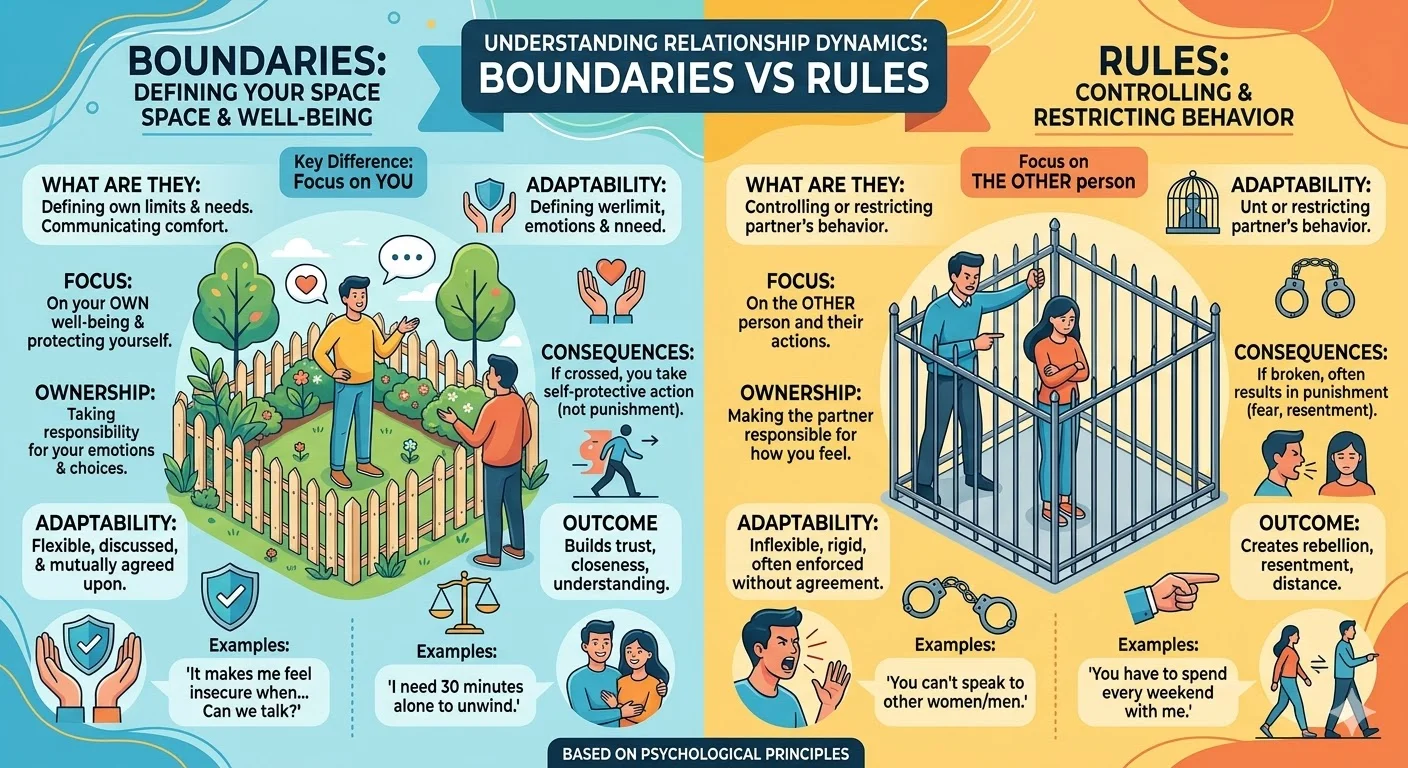
To cultivate healthier dynamics, we must directly answer a fundamental question early on. Boundaries vs rules represent entirely different psychological postures within a relationship. Boundaries are limits established to protect your own emotional and physical well-being. Rules, conversely, are directives aimed at controlling or restricting another person. Recognizing this fundamental division prevents long-term resentment.
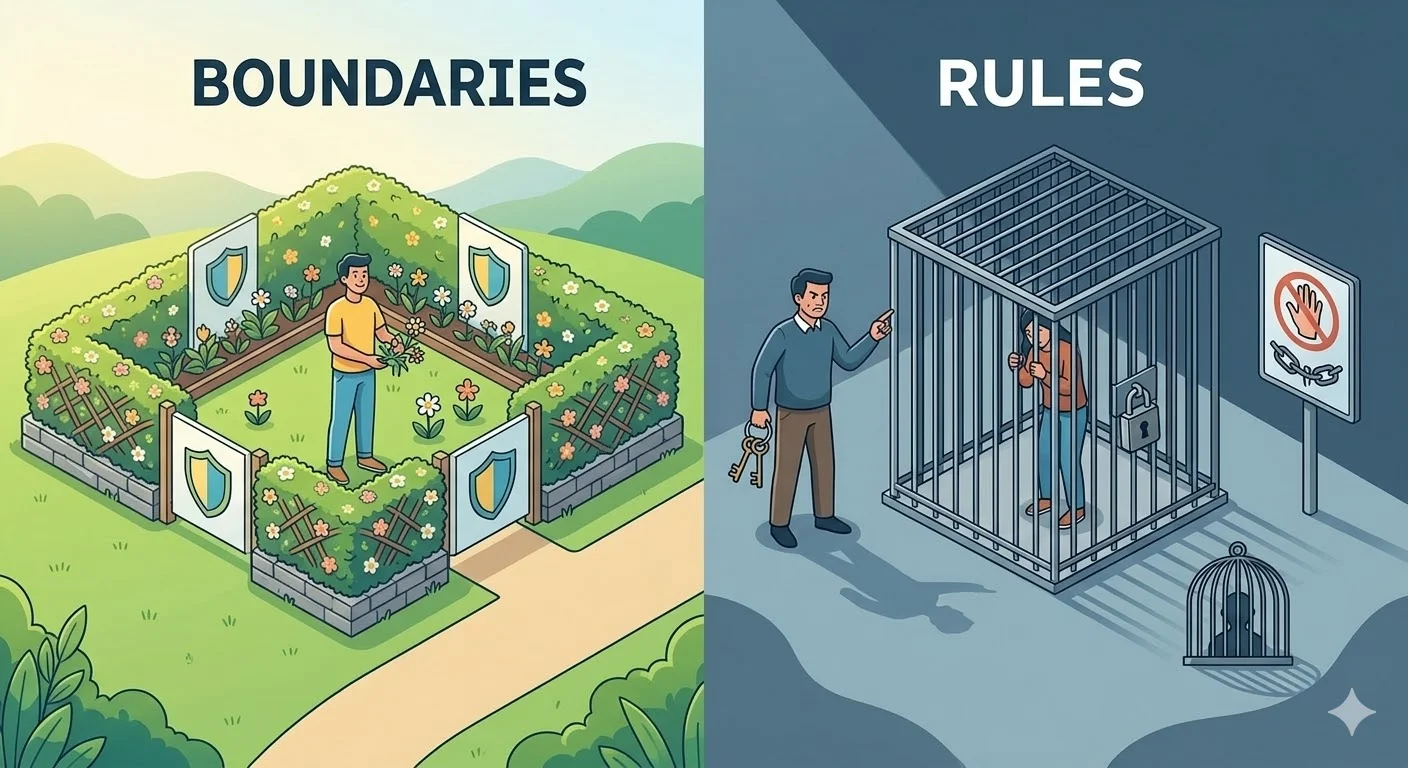
A helpful psychological analogy visualizes a boundary as a secure garden fence. You represent the garden, and the fence defines your personal space and tolerance limits. People can still interact with you over this structure, but it clearly communicates your comfort zone. This psychological barrier remains stable, yet it allows necessary flexibility for healthy social interaction.
Conversely, imposing a rule functions like building a restrictive cage around your partner. You attempt to confine their behavior into a space you deem appropriate or safe. If they break these behavioral mandates, they typically face punitive consequences. This critical distinction highlights that boundaries focus entirely on yourself, while rules focus primarily on managing others.
What Is the Core Difference Between Boundaries vs Rules?
The true difference becomes apparent when we examine psychological ownership and emotional responsibility. When communicating personal boundaries, the primary focus remains securely on your internal needs and self-protection. You articulate what you require to feel safe and respected. The responsibility for maintaining that safety rests squarely on your own shoulders, empowering your decision-making process.
Imposing rules shifts that entire emotional burden onto the other individual. You make your partner responsible for your feelings, often stating that their non-compliance causes your distress. This dynamic strips away their autonomy while simultaneously masking your underlying insecurities. Healthy connections require both individuals to take complete ownership of their own emotional reactions and choices.
Fostering Personal Autonomy vs Restricting Behavior
Rules inherently restrict autonomy by dictating acceptable behavior through rigid expectations. They function as inflexible mandates that rarely stem from mutual agreement or open discussion. Boundaries, however, preserve autonomy for everyone involved by offering clear choices. They outline your personal limits while explicitly allowing the other person the freedom to choose their subsequent response.
Cultivating Mutual Understanding vs Enforcing Consequences
Rules rely heavily on enforcement and the looming threat of punishment. Non-compliance often results in the silent treatment, verbal outbursts, or the withdrawal of affection. When someone crosses a boundary, the healthy response involves protective action rather than retribution. You simply implement the necessary steps to safeguard your well-being, such as temporarily creating physical distance.
Clinical Insights on Healthy Relationship Limits
Clinical evidence consistently demonstrates that rigid relationship rules breed resentment and relational rebellion. When individuals feel controlled or punished, they naturally pull away, creating profound emotional distance. Over time, these controlling mechanisms erode the foundational trust required for intimacy. Punitive frameworks fail to encourage mutual growth, pushing partners further apart instead of bringing them together.
Healthy boundary-setting yields entirely different psychological outcomes for both individuals. Clearly communicating personal limits fosters a secure environment characterized by mutual understanding and deep trust. Let us examine a practical example of a rule versus a boundary. Saying that a partner cannot speak to certain people is a restrictive rule born from insecurity and fear.
A healthier approach involves expressing vulnerability and stating your personal threshold. You might explain that specific interactions trigger your insecurities, inviting an open dialogue about mutual comfort levels. Stating that you need time alone after work is a classic boundary. It honors your psychological need to decompress without dictating how your partner must spend their time.
Applying Concepts to Complex Relationship Dynamics
Non-monogamous relationships provide an excellent lens for examining these psychological concepts. These diverse dynamics offer significant freedom but often introduce heightened complexities requiring careful navigation. During the initial phases of opening a relationship, couples frequently establish strict ground rules to manufacture a sense of safety. These early rules attempt to mitigate fear through behavioral control.
As emotional security deepens, these rigid directives must evolve into flexible boundaries. Partners must explore their individual comfort levels and take responsibility for their distinct emotional responses. If someone crosses an established line, a punitive reaction maintains a rule-based dynamic. Conversely, taking self-protective action while communicating distress reflects a mature, boundary-oriented approach to conflict resolution.
Conclusion
Navigating the delicate interplay between self-protection and interpersonal connection requires deep self-awareness. It remains perfectly valid to feel anxious when establishing limits, as true vulnerability feels inherently risky. Shifting from controlling directives to protective self-advocacy transforms relationships from battlegrounds into safe havens. Your psychological well-being depends on your ability to clearly define your personal space.
Embrace the ongoing process of understanding your internal needs and communicating them authentically. Cultivating this skill requires practice, patience, and a willingness to tolerate temporary discomfort. Moving forward, focus on honoring your emotional limits while respecting the autonomy of those around you. This grounded approach ultimately paves the way for deeper, more authentic human connections.
Key Takeaways
- Boundaries focus on protecting your emotional well-being through defined personal limits.
- Rules attempt to manage, restrict, or control another person’s behavior.
- Healthy relationships require mutual autonomy rather than rigid behavioral mandates.
- Establishing psychological safety means taking responsibility for your own emotional responses.
- Moving from punitive rules to flexible boundaries fosters deeper intimacy and trust.
References
- Bowlby, J. (1982). Attachment and loss: Retrospect and prospect. American Journal of Orthopsychiatry, 52(4), 664-678.
- Cloud, H., & Townsend, J. (1992). Boundaries: When to say yes, how to say no to take control of your life. Zondervan.
- Gottman, J. M., & Silver, N. (2015). The seven principles for making marriage work. Harmony Books.
- Linehan, M. M. (2014). DBT skills training manual (2nd ed.). Guilford Publications.
- Mellody, P., Miller, A. W., & Miller, J. K. (1989). Facing codependence: What it is, where it comes from, how it sabotages our lives. HarperSanFrancisco.