

The Psychology of Connection: Understanding Boundaries vs Rules in Relationships
In clinical practice, a frequent source of interpersonal conflict stems from a fundamental misunderstanding of personal limits. Couples often arrive in therapy feeling exhausted because their stated needs remain unmet. However, closer assessment usually reveals a critical confusion. Navigating boundaries vs rules in relationships is essential for cultivating lasting intimacy and psychological safety. When we cannot distinguish between protecting our emotional space and managing another person, resentment inevitably builds.
Understanding this distinction shifts a relationship from a dynamic of control to one of mutual respect. A boundary fosters connection by providing clarity, while a rule often breeds defensiveness and distance. By examining the psychological mechanisms behind these concepts, partners can develop healthier communication patterns. This approach empowers individuals to advocate for their needs without diminishing their partner’s autonomy.
Defining the Core Concepts
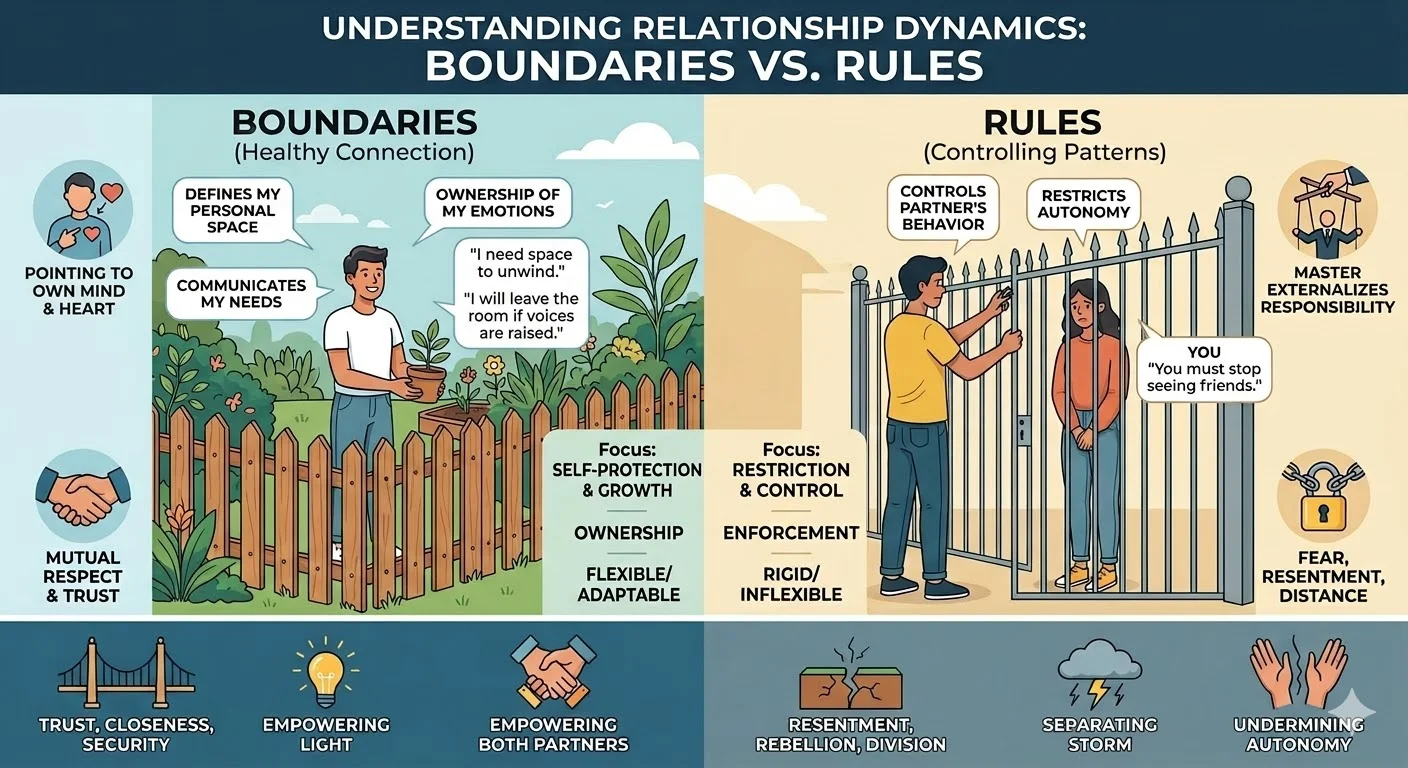
To establish a foundation for healthy connection, we must first define our terms clearly. A boundary is an internal limit that dictates what you will accept and how you will respond to specific behaviors. It is about taking ownership of your emotional well-being and communicating your personal property line. Boundaries always focus on your own actions and choices rather than the actions of others.
Conversely, a rule is an external mandate imposed upon another person to control or restrict their behavior. Rules operate on a framework of compliance and consequence, often rooted in underlying anxiety or insecurity. When a partner sets a rule, they shift the responsibility for their emotional regulation onto the other person. This externalizes the problem and strips the partner of their independent choice.
What Are the Key Differences Between a Rule and a Boundary?
The distinction between these two concepts becomes apparent when we observe how they operate in daily interactions. The most significant psychological divergence lies in the locus of control. Setting personal limits involves identifying your own needs and making decisions that honor those needs. You are stating what you will do if a certain situation arises, which maintains your own autonomy.
When applying rules, the locus of control is externalized. Controlling behavior in couples typically manifests as demands placed on the partner to behave in a highly specific manner. The subtext is that the partner must change to alleviate the anxious individual’s discomfort. This dynamic inherently lacks flexibility and often triggers an automatic defensive response, leading to cycles of conflict.
Communication Styles and Emotional Ownership
Interpersonal communication provides another clear metric for distinguishing between the two concepts. Boundaries are communicated with “I” statements and express a personal truth. For example, a boundary might sound like a statement that you will not engage in a conversation if voices are raised. This communicates a standard for your own participation without demanding the other person change their tone.
Rules rely heavily on “you” statements and absolute directives. A rule sounds like a demand that the partner must never raise their voice during a disagreement. While the desired outcome might appear similar, the psychological impact is vastly different. The rule attempts to force compliance, whereas the boundary protects the self and invites the partner to adjust their approach voluntarily.
Why Do We Mistake Rules for Boundaries?
The confusion often originates from a deep desire for emotional safety. Individuals who struggle with anxiety or who have experienced past relational trauma may attempt to create security through control. They label their rules as boundaries to legitimize their demands and avoid the vulnerability of true emotional ownership. This is a protective mechanism designed to prevent anticipated pain or betrayal.
Unfortunately, this strategy usually backfires and damages the relationship dynamic patterns. Psychological safety cannot be manufactured through restriction. It must be built through mutual trust and the voluntary honoring of each other’s needs. Recognizing this defense mechanism is a crucial step in clinical work, allowing individuals to address their underlying fears rather than projecting them onto their partner.
How to Shift from Controlling Rules to Healthy Boundaries
Transitioning from a rule-based dynamic to a boundary-based dynamic requires deliberate practice and self-reflection. The first step is to redirect your focus inward. When you feel the urge to dictate your partner’s behavior, pause and identify the core emotion driving that urge. Ask yourself what you need to feel safe and how you can provide that safety for yourself.
Next, reframe your communication to center on your own actions. Instead of forbidding a partner from making certain jokes, inform them that you will leave the room if such jokes are made. This boundary setting psychology empowers you to manage your environment without infringing on their autonomy. It allows your partner the freedom to choose their behavior and face the natural outcome.
Finally, accept that true boundaries require a willingness to tolerate discomfort. If you set a limit, you must be prepared to follow through with the corresponding action. This consistency is what builds trust over time. It demonstrates that your words have meaning and that you are fully capable of protecting your own emotional well-being within the relationship.
Conclusion
Navigating the complexities of human connection requires a deep understanding of our own limits. Recognizing the difference between rules and boundaries is a transformative step toward relational maturity. It allows us to release the exhausting burden of trying to control others. By focusing on our own emotional property lines, we create a space where genuine intimacy and respect can flourish.
It is completely natural to desire a sense of predictability and safety with the people we love. However, true security comes from knowing you can handle whatever arises, not from forcing your partner into a rigid framework. As you practice communicating your internal limits, you will likely find that your relationship becomes more resilient, authentic, and deeply fulfilling.
Key Takeaways
- Boundaries protect your own emotional and physical space, whereas rules attempt to control the behavior of another person.
- Healthy limits are communicated using “I” statements and focus on your own responses to specific situations.
- Rules are often born from underlying anxiety and a desire to manufacture safety through external compliance.
- Shifting to a boundary-based approach requires taking full ownership of your emotional regulation and personal choices.
- True psychological safety in a partnership is built on mutual autonomy rather than restrictive mandates.
References
- Brown, B. (2015). Rising strong: The reckoning, the rumble, the revolution. Spiegel & Grau.
- Gottman, J. M., & Silver, N. (2015). The seven principles for making marriage work: A practical guide from the country’s foremost relationship expert. Harmony Books.
- Porges, S. W. (2017). The pocket guide to the polyvagal theory: The transformative power of feeling safe. W. W. Norton & Company.
- Tatkin, S. (2016). Wired for dating: How understanding neurobiology and attachment style can help you find your ideal mate. New Harbinger Publications.
- Tawwab, N. G. (2021). Set boundaries, find peace: A guide to reclaiming yourself. TarcherPerigee.