
Mapping the Blueprint of Emotional Intimacy: A Clinical Look at Attachment Styles
Relationships often feel like a complex puzzle. Many of my clients describe feeling trapped in repetitive emotional cycles that leave them exhausted. They long for deep connection but repeatedly face the same emotional roadblocks. Clinical psychology offers profound clarity for these relational patterns through the lens of attachment theory.
By exploring your early emotional conditioning, you can uncover the blueprint of your adult relationships. Utilizing an attachment styles test pdf provides a structured method to evaluate these behaviors objectively. This assessment tool offers a scientific framework to identify whether your primary relationship strategy leans toward secure, anxious, avoidant, or fearful patterns.
What Are Attachment Styles?
Attachment styles are stable psychological frameworks that dictate how individuals perceive, experience, and respond to emotional intimacy in relationships. These subconscious blueprints originate from early interactions with primary caregivers and significantly influence adult relational dynamics. They shape our core expectations regarding trust, dependency, and emotional safety.
In clinical practice, we observe that these early experiences wire the nervous system to respond to intimacy in predictable ways. When a child receives consistent care, they develop a baseline of emotional security. Inconsistent or absent care forces the developing infant brain to adopt adaptive strategies to manage emotional distress.
Recognizing these deeply ingrained patterns is the critical first step toward intentional psychological growth and healthier interpersonal connections. The way you currently handle conflict with a partner often mirrors the exact coping mechanisms you subconsciously developed decades ago to protect yourself.
The Core Psychological Mechanisms
Bowlby and Ainsworth established that human beings possess a biological drive to form deep emotional bonds. This drive operates completely independently of basic survival needs like food and shelter. The human brain simply requires a safe relational haven to regulate stress and process complex emotional states effectively.
Exploring the Four Primary Attachment Categories
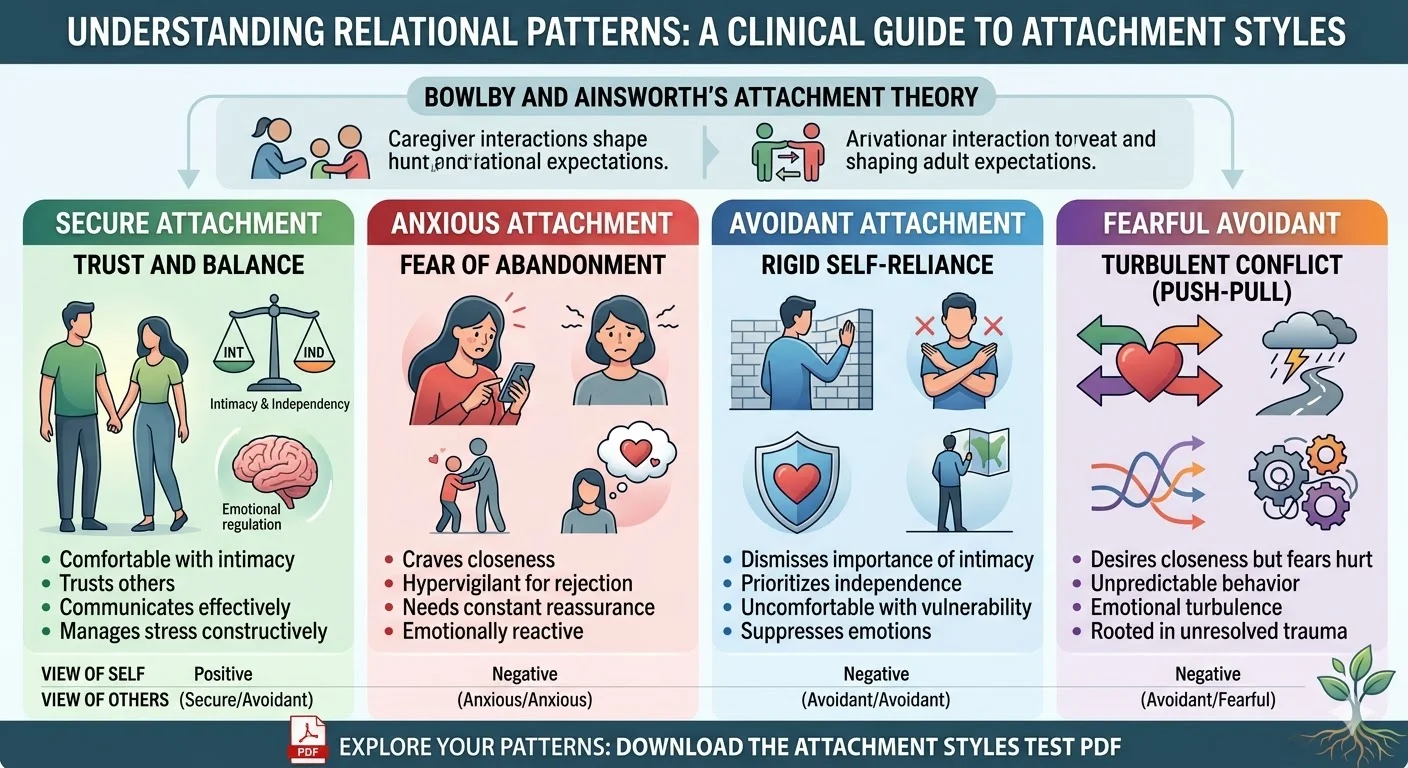
Psychological research categorizes human relational behavior into four distinct paradigms. Understanding these specific categories allows individuals to conceptualize their emotional responses objectively and without judgment. We utilize these classifications in clinical therapy not as permanent pathological labels, but rather as dynamic, evolving roadmaps for profound personal development.
Secure Attachment
Individuals with secure attachment patterns demonstrate high levels of emotional resilience and relational trust. They feel comfortable relying on their partners and readily allow their partners to depend on them. These individuals navigate emotional vulnerability with confidence and maintain a healthy balance between personal independence and mutual intimacy.
A securely attached person does not panic when a romantic partner requests space. For example, if a spouse travels for work, the secure individual maintains emotional stability rather than spiraling into anxiety. They process conflict constructively and view temporary disagreements as natural components of a committed relationship.
Anxious Attachment
Anxious attachment manifests as an intense craving for emotional closeness coupled with a pervasive fear of abandonment. People with this style frequently rely on external validation to regulate their self worth. They often engage in hypervigilant monitoring of their partner for any subtle signs of emotional rejection or sudden withdrawal.
Clinically, this looks like heightened emotional reactivity when a simple text message goes unanswered. An anxiously attached individual might automatically interpret a partner being quiet as a sign of an impending breakup. They often utilize physical closeness as a primary mechanism to soothe their highly activated nervous system.
Avoidant Attachment
The avoidant attachment style is characterized by a strong preference for emotional self reliance and a deep discomfort with vulnerability. These individuals often suppress their fundamental emotional needs to maintain a rigid sense of absolute independence. They unconsciously view mutual dependency as a severe threat to their personal autonomy.
In real world scenarios, avoidant individuals tend to create physical or emotional distance when a relationship becomes highly intimate. They might suddenly focus entirely on their career or emphasize minor flaws in their partner to justify pulling away. This distancing serves as a powerful subconscious protective mechanism against perceived engulfment.
Fearful Avoidant Attachment
Fearful avoidant attachment involves a complex psychological combination of profound anxiety and intense avoidance. Individuals with this pattern desperately desire close emotional bonds but remain deeply terrified of being hurt or betrayed. This internal conflict almost always stems from unresolved early relational trauma or highly unpredictable caregiving environments.
This style creates a turbulent push and pull dynamic in adult romantic relationships. The very person they seek for emotional comfort is simultaneously perceived as a potential source of emotional danger. Consequently, their relationships frequently feature dramatic highs and unpredictable lows that eventually exhaust the emotional reserves of both partners.
How Does an Assessment Tool Provide Clinical Insight?
Many clients struggle to articulate their emotional experiences without a structured psychological framework. Utilizing a standardized questionnaire helps organize chaotic emotional histories into clear, measurable psychological patterns. When you review your answers objectively, you can identify the specific blind spots that have sabotaged your previous attempts at lasting emotional intimacy.
Taking a formal assessment provides an excellent baseline for targeted therapeutic intervention. By analyzing specific relationship behaviors and emotional triggers, we can pinpoint exactly where your interpersonal communication breaks down. This targeted approach allows for the development of precise, actionable strategies to foster long term relational security.
Conclusion
Recognizing your attachment style is a powerful step toward emotional freedom. Your relational patterns are learned survival behaviors rather than permanent personality flaws. While early experiences shaped your initial emotional responses, neuroplasticity ensures that you possess the biological capacity to develop secure and healthy connections at any stage of life.
I encourage my clients to approach their emotional history with deep compassion and academic curiosity. Healing requires consistent effort, increased self awareness, and often professional therapeutic support. By committing to this psychological work, you can transform generational cycles of pain into a beautiful legacy of profound relational security.
Key Takeaways
- Attachment patterns originate in childhood but profoundly dictate adult relationship dynamics.
- Secure individuals effectively balance personal independence with deep emotional intimacy and trust.
- Anxious and avoidant behavioral patterns serve as subconscious protective mechanisms against perceived emotional threats.
- Standardized assessment tools provide a structured framework to identify your specific emotional triggers objectively.
- Therapeutic intervention and conscious effort can successfully shift insecure behaviors toward secure attachment over time.
References
- Bowlby, J. (1982). Attachment and loss: Retrospect and prospect. American Journal of Orthopsychiatry, 52(4), 664-678.
- Brennan, K. A., Clark, C. L., & Shaver, P. R. (1998). Self-report measurement of adult attachment: An integrative overview. In J. A. Simpson & W. S. Rholes (Eds.), Attachment theory and close relationships (pp. 46-76). Guilford Press.
- Fraley, R. C., Waller, N. G., & Brennan, K. A. (2000). An item-response theory analysis of self-report measures of adult attachment. Journal of Personality and Social Psychology, 78(2), 350-365. https://doi.org/10.1037/0022-3514.78.2.350
- Hazan, C., & Shaver, P. (1987). Romantic love conceptualized as an attachment process. Journal of Personality and Social Psychology, 52(3), 511-524. https://doi.org/10.1037/0022-3514.52.3.511
- Mikulincer, M., & Shaver, P. R. (2016). Attachment in adulthood: Structure, dynamics, and change (2nd ed.). Guilford Press.